
The Internet is a Place
— and it’s one where we now spend a significant portion of our lives.
Constitutional protections must follow us there.
The Fourth Amendment, while originally conceived around physical space and tangible property, was clearly designed to draw an explicit line preventing the Government from overstepping its newly granted authority.
A plain text reading shows this.
(Presented here in sections for clarity and comment with no alterations to the text itself):
The right of the people to be secure in their persons, houses, papers, and effects, against unreasonable searches and seizures, shall not be violated
There is no ambiguity in this clause — the word “unreasonable” is not a loophole, because the remainder of the text tells us exactly what it means.
It places the onus on the Government — defining the sole conditions under which a violation of this right may be justified.
and no Warrants shall issue, but upon
probable cause, supported by Oath or affirmation,
and particularly describing the place to be searched,
and the persons or things to be seized.
The right is total — and the state's role is to secure, not to suspect.
Read any other way, and the second clause does no work.
A text that guarantees a right contains no decorative clauses.
Courts have carved exceptions, some defensible — others less so — but exceptions to a total right do not diminish it; they define its boundary. What they have never done is invert the default.
A valid warrant does not erase your Fourth Amendment right — it justifies an intrusion that would otherwise violate it, which is precisely why the standards are so demanding: sworn probable cause, specificity of scope, and prior judicial approval. Anything short of that process is an unjustified violation.
Our Digital Homes, Papers, & Effects
My home network is a part of my physical house.
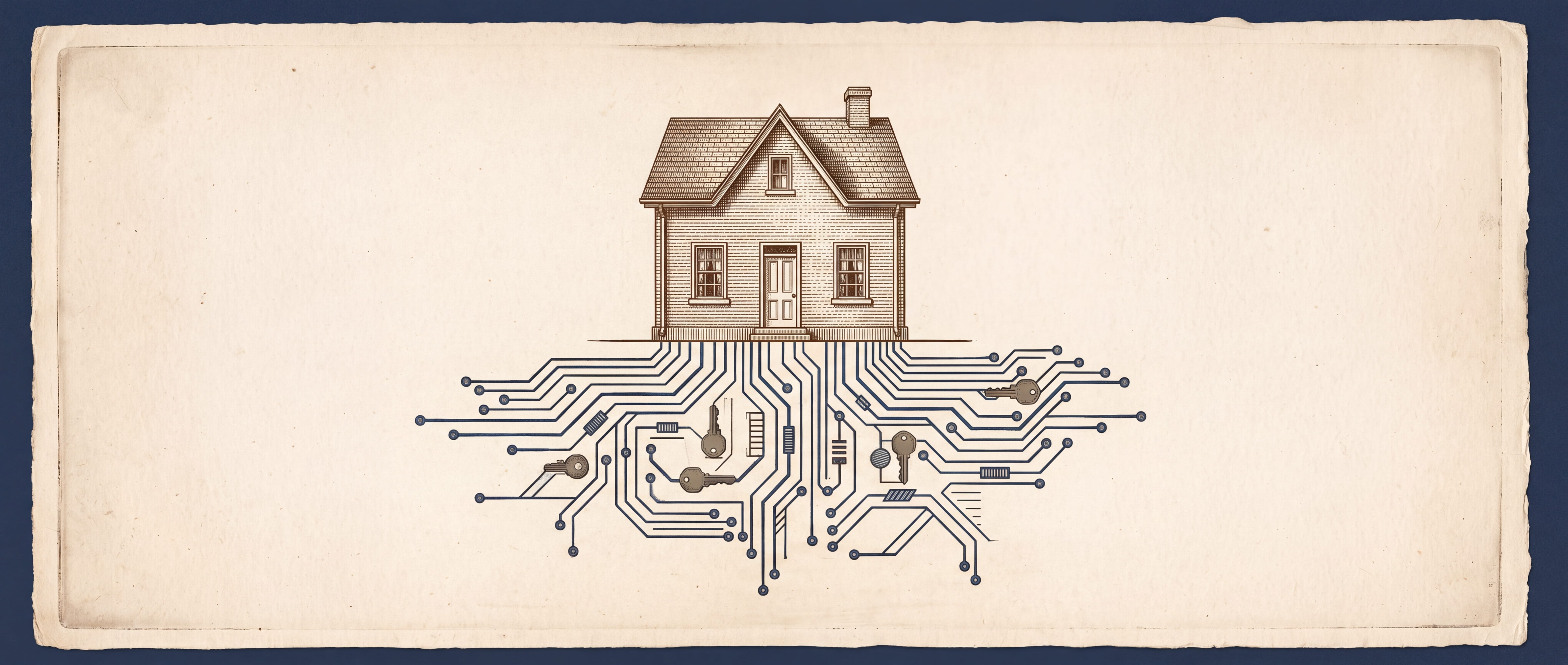
But if we understand the Internet as a place and not a thing, my IP address now functions as my digital street address… and my home network is my ‘digital dwelling’.
My devices are the rooms. My files are the papers. My online accounts are drawers and cabinets where my effects and correspondence are kept.
My IP address locates this digital dwelling within my physical house — the Fourth Amendment makes no distinction between these two types of doorways.
No one argues that having a street address strips the home located at that address of these protections — the address is simply how the state finds the place it must justify entering.
In view of this analogy, it would clearly follow that we have a right to store our data privately, and thus we have the right to secure our data to do so.
I have a right to be sheltered.
I have a right to be clothed.
My home network is my shelter.
Encryption is my clothing.
My ad-blocker is my refusal of uninvited guests.
My VPN and anti-fingerprinting tools are my drawn curtains —
my refusal to be watched in my own home.
The Digital Back-Door
Unfortunately, the courts built a back-door into the Fourth Amendment and called it 'the third-party doctrine'.
In it, the courts reasoned that information shared with a third party is information you’ve chosen to expose.
Under it, nearly everything you do online has been deemed unprotected — every message, every search, every record held by anyone but you.
The law has long known the difference between custody and ownership. For nearly a century and a half, a sealed letter has kept its protection in the hands of the postal service — the government may read the envelope, but not the letter, without a warrant.
Digital life breaks even this concession. Our metadata is the “envelope” of our digital messages — its addressing, its timing, its source and destination — but in this form, it records movements, associations, and habits no envelope ever disclosed.
A postmark fades… but a log does not.
What in physical space is ephemeral and isolated is now permanent… and aggregated.
And in this way, our metadata is not just the outside of the letter.
By definition, it reveals content about the content — now preserved, aggregated, and assembled into a profile.
The third-party doctrine’s quietest move was its cruelest: it shifted the burden.
The Fourth Amendment requires the state to justify its actions, whereas the third-party doctrine places a burden of fortification on the citizen in order for the right to be upheld. Encrypt, self-host, opt-out, or be deemed to have consented to losing this right.
That is unreasonable.
Encryption requires a level of awareness and tech savvy not all citizens will possess.
Self-hosting imposes a cost not all citizens can afford.
And to “opt-out” of being online is functionally impossible in the age we find ourselves living in.
Inherent and unalienable rights do not come with conditions — a right that must be fortified is a right that has already been breached.
What the Home Shelters
Houses were never the point. Papers were never the point.
The containers were protected because of what they contained.
Today, our private lives live in our data.
The category holds; only the medium changed.
In one generation the Internet has evolved from novelty, to essential utility, to the place we spend most of our time.
The Framers explicitly protected “papers” not because paper itself is special, but because that is where a person's private life was lived.
The letters, the diaries, the drafts no one was meant to read — they protected them because they knew what lived inside: the inner life, the self still in draft.
Our ability to know ourselves is contingent upon possessing the freedom to become ourselves — and becoming oneself requires time… and privacy.
What we read, what we write and delete, what we wonder at and pursue in private — this is the substance the Fourth Amendment was built to shelter.
Today that substance lives almost entirely in digital spaces. The third-party doctrine, which excludes those spaces, has not simply diminished the right; it has abandoned it.
Data Privacy Rights are not privileges to be legislated into existence, but rights the Fourth Amendment has always held, which demand new recognition in our digital context.